Don’t miss our content
SubscribeA team of students from IE University were declared the winners of the Spanish national rounds of the 2026 Philip C. Jessup International Law Moot Court Competition, after defeating the team from Universidad Carlos III de Madrid in the final round. For the 16th consecutive year, this time at the Barcelona office, Cuatrecasas held the national rounds of the competition that is internationally recognized as a global leader in judicial simulations for university students.
From February 10 to 12, 52 law students from 11 Spanish universities—organized into teams and supported by 27 coaches—had the opportunity to perfect skills and competencies that are essential for their career development, such as oral presentations, teamwork and the development of a well-founded and rigorous legal argument. The universities participating were ESADE Business & Law School, Universidad Pontificia Comillas-ICADE, IE University, Universidad Autónoma de Madrid, Universidad Carlos III de Madrid, Universidad de Deusto, Universidad de La Laguna, Universidad de Lleida, Universitat Autónoma de Barcelona, Universitat de Barcelona, and Universitat Pompeu Fabra.
This year, the competition was centered on “The Case Concerning the Gordian Gorge,” a fictional case that addressed—among other highly complex issues—(i) who is entitled to participate in proceedings before the International Court of Justice; (ii) the rights of indigenous people with respect to rare earth minerals located in their territories; (iii) the “general principles of law recognized by civilized nations”; and (iv) the circumstances under which a state-owned company can claim immunity from the national jurisdiction of another state.
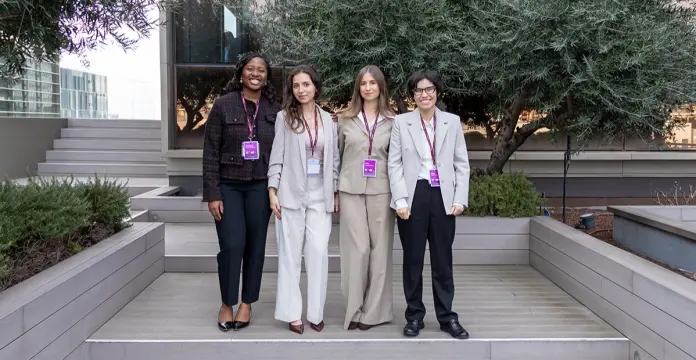
Following relevant deliberations and evaluation, the judging panel—formed by some of our lawyers, experts in international law, academics, and university lecturers, former participants and officials of international bodies—announced the team from IE University as the winners. The team was made up of students Alexa Couttolenc Gutiérrez, Omobolaji Ebubechukwu Olalere, María Luiza Hadi El Awar and Sabina Narváez González; and was advised by coaches Gabriela Echeverría Gutiérrez and Sebastián Green Martínez. The other finalists were the team from Universidad Carlos III, formed by Diana Barbero Pareja, Sara Duque Ruzafa, Rodrigo Pérez Díez, Víctor Manuel Pezuela Ortiz and Candela Segovia Martínez-Villa. Both teams will represent Spain in the competition’s international rounds.
Queralt Vidal, lawyer from the Swiss law firm MLL Legal, and judging panel member, spoke about this edition: “This year, the level of the participants was very high, considering they were faced with a complex case. The 11 teams did a great job researching to defend their arguments and they gave it their all. Clearly they spent many hours preparing for this. They knew how to respond to and face the questions, controlling the situation at all times. What surprised me the most was the students’ incredible knowledge of international law. For that reason, I see a lot of potential for the international rounds and I think we will play a huge role in Washington.”
Alexa Couttolenc Gutiérrez and Sabina Narváez González, members of the winning team, said: “We never thought we would reach the final of the national rounds, and it will be an honor to represent Spain in the international rounds. Thanks to Jessup, this experience has given us confidence and we have discovered our passion for international law.”
The Philip C. Jessup International Law Court Competition, held for the first time in 1960, is the largest international legal simulation competition, attracting participants from over 700 law schools in over 100 countries. The winning teams from each country will compete in the final international rounds, which will be held in Washington D.C. from March 28 to April 4.
Don’t miss our content
Subscribe